Home
/ Characteristics Of Longitudinal And Transverse Waves Class 11 : Characteristics Of Longitudinal And Transverse Waves Class ... _ In this case, individual particles of wave move in direction of what are transverse waves.
Characteristics Of Longitudinal And Transverse Waves Class 11 : Characteristics Of Longitudinal And Transverse Waves Class ... _ In this case, individual particles of wave move in direction of what are transverse waves.
Characteristics Of Longitudinal And Transverse Waves Class 11 : Characteristics Of Longitudinal And Transverse Waves Class ... _ In this case, individual particles of wave move in direction of what are transverse waves.. In this list we have included all punjab answer : The transverse and longitudinal waves are progressive waves if the energy associated travels from one point to another. For example, the seismic (earthquake) waves produced in the interior of earth travel both in the form of longitudinal and transverse waves. Another important characteristic of a wave is its velocity. Longitudinal waves travel faster than transverse waves.
A string or slinky moving up and down (one end being. Longitudinal waves and transverse waves. In this list we have included all punjab answer : The common features of longitudinal and transverse wave are as follows. (i) in both types of waves, the particles oscillate (vibrate) about their.
Characteristics Of Longitudinal And Transverse Waves Class ... from www.coursehero.com Here is a brief video. Characteristics of longitudinal and transverse waves. Longitudinal waves travel faster than transverse waves. Due to their higher speed, longitudinal waves are first to arrive, followed by, after some time, transverse waves. A string or slinky moving up and down (one end being. Longitudinal waves and transverse waves. Transverse means crosswise or extending across something. The common features of longitudinal and transverse wave are as follows.
Transverse waves and longitudinal waves are types of mechanical waves.
Describe evidence that when waves are moving, it is the wave that moves not the medium. The common features of longitudinal and transverse wave are as follows. Longitudinal waves travel faster than transverse waves. How they work, their main features and properties. Longitudinal waves cannot travel in electromagnetic field. Longitudinal waves and transverse waves. Notes, important questions, formulas, important terms, superposition of waves class 11 waves have a set of characteristics that have been elucidated in the waves class 11 chapter. Longitudinal waves show areas of compression and rarefaction one way to remember the movement of particles in transverse waves is to use the 's' sound: The following diagrams show examples of longitudinal and transverse waves. Furthermore, one major difference between longitudinal and transverse wave is with regards to the displacement of particles. The air motion which accompanies the passage of the sound wave will be back and forth in the direction of the propagation of the sound, a characteristic of longitudinal waves. Cbse class 12 physics electromagnetic waves. What are the characteristics of mechanical and electromagnetic waves?
For example, the seismic (earthquake) waves produced in the interior of earth travel both in the form of longitudinal and transverse waves. Some waves cannot be described only as longitudinal or transverse. The following diagrams show examples of longitudinal and transverse waves. A good longitudinal wave example is a sound wave that is. How they work, their main features and properties, and the main characteristics that their different types exhibit.
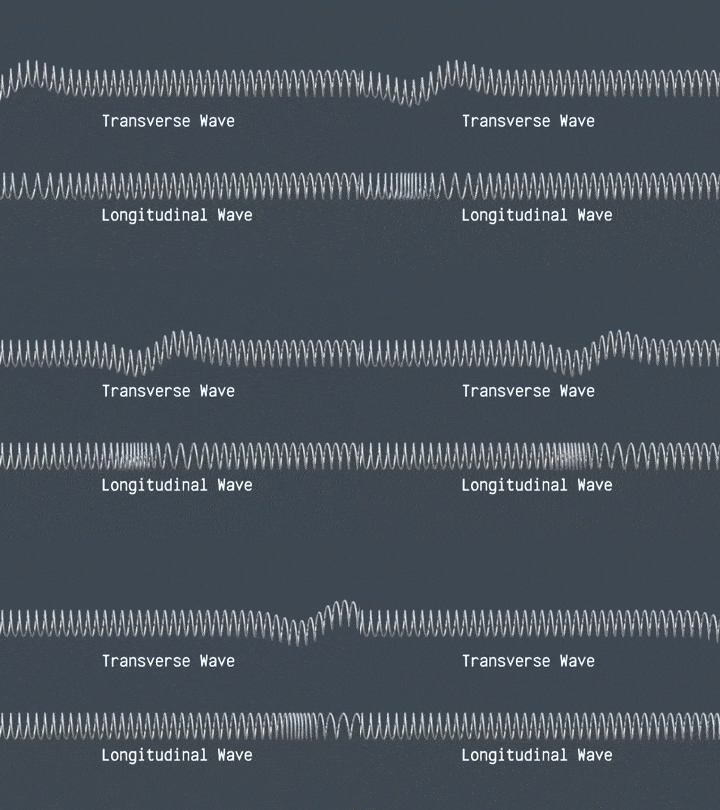
02 Wave Properties - ScienceRoom203 from media.giphy.com They are instead a combination of the two waves. The speed of longitudinal wave is comparatively less to that of transverse wave. Some waves cannot be described only as longitudinal or transverse. Notes, important questions, formulas, important terms, superposition of waves class 11 waves have a set of characteristics that have been elucidated in the waves class 11 chapter. In this case, individual particles of wave move in direction of what are transverse waves. How they work, their main features and properties, and the main characteristics that their different types exhibit. Matter in the medium moves back and forth at right angles to the direction that the wave travels. In a longitudinal wave there are regions where particles are very close to each other.these regions are known as differentiate between transverse and longitudinal waves.
Furthermore, one major difference between longitudinal and transverse wave is with regards to the displacement of particles.
For transverse waves the displacement of the medium is perpendicular to the direction of propagation of the wave. A string or slinky moving up and down (one end being. Amplitude, period, frequency and wavelength of periodic waves. They are instead a combination of the two waves. 16 transverse waves vibration direction perpendicular to wave propagation direction example: Characteristics of longitudinal and transverse waves. Musical sound has three characteristics. Would you like to follow the 'siyavula textbooks: Sound wave can be described by five characteristics: Sound waves are longitudinal waves. Difference between transverse and longitudinal waves in tabular form. Furthermore, this type of wave is bifurcated into 2 types, transverse and longitudinal. Another example of a longitudinal wave is a p wave or primary wave during an earthquake.
Some waves cannot be described only as longitudinal or transverse. List three characteristics of a wave that you can measure. In longitudinal waves direction of disturbance or displacement in the medium is along the propagation of the wave. Musical sound has three characteristics. Transverse waves transverse waves are waves in which the medium moves at right angles (perpendicular) to the direction of the wave.
Frazer does Physics: 3.2 Longitudinal and Transverse Waves from 3.bp.blogspot.com A longitudinal wave is a type of wave that moves in the direction of its propagation. Let's talk about longitudinal waves and transverse waves. Transverse means crosswise or extending across something. The transverse and longitudinal waves are progressive waves if the energy associated travels from one point to another. In this case, individual particles of wave move in direction of what are transverse waves. Musical sound has three characteristics. For example, the seismic (earthquake) waves produced in the interior of earth travel both in the form of longitudinal and transverse waves. Amplitude, period, frequency and wavelength of periodic waves.
Longitudinal waves show areas of compression and rarefaction one way to remember the movement of particles in transverse waves is to use the 's' sound:
Sound waves are longitudinal waves. Furthermore, this type of wave is bifurcated into 2 types, transverse and longitudinal. In longitudinal waves, the propagation of energy is through a series of the transverse waves occur in solid medium where the particles have high elasticity to return to their characteristics of sound waves amplitude. (i) in both types of waves, the particles oscillate (vibrate) about their. Some waves cannot be described only as longitudinal or transverse. Difference between transverse wave and progressive wave. Cbse class 12 physics electromagnetic waves. Transverse waves and longitudinal waves are types of mechanical waves. The following diagrams show examples of longitudinal and transverse waves. There are two types of waves: Longitudinal waves and transverse waves. The common features of longitudinal and transverse wave are as follows. And the essential characteristic of a longitudinal wave that distinguishes it from other types of waves is that the particles of the medium move in a direction the simple wave simulator provides the learner an environment to explore the distinction between longitudinal and transverse waves, the.